Alberta Tenant Rights: Lease Help Under the Residential Tenancies Act
Alberta is one of the few Canadian provinces with no province-wide rent control. While this gives landlords more flexibility to raise rents, Alberta tenants still have meaningful protections around deposits, notice periods, and dispute resolution through the RTDRS.
The Alberta RTA & the RTDRS
Alberta's Residential Tenancies Act (RTA) establishes the rights and obligations of landlords and tenants across the province. It covers security deposits, entry rights, notice periods, assignment and subletting, and eviction procedures. The Residential Tenancy Dispute Resolution Service (RTDRS)handles most landlord-tenant disputes outside of court — it is faster and less expensive than civil litigation.
Unlike Ontario's LTB or BC's RTB, Alberta's RTDRS operates more like an arbitration service: hearings are conducted in-person or by telephone, and either party can apply. RTDRS orders are legally binding and enforceable as court judgments.
No Rent Control in Alberta
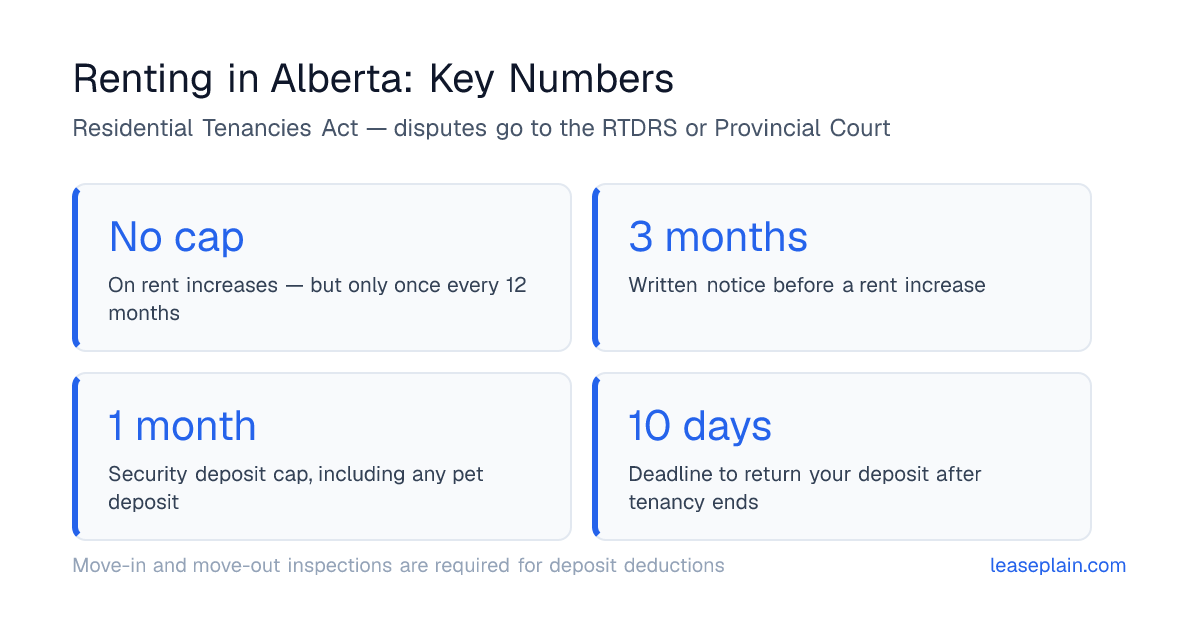
Alberta has no province-wide rent control. A landlord can raise your rent by any amount — but they can only do so once per year, and they must give you at least 3 months written notice before the increase takes effect. If your landlord tries to raise rent more frequently or with shorter notice, the increase is not valid. You do not have to pay it.
Key Tenant Protections in Alberta
- Security deposits are capped at one month's rent — this is the maximum regardless of lease length.
- Landlords must provide a statement of account within 10 days of tenancy end. The final statement of account must be delivered within 30 days of possession being given up.
- For a fixed-term lease, landlords must give at least 3 months notice if they do not intend to renew.
- Month-to-month tenants must receive at least 3 months notice to vacate; week-to-week tenants require one week's notice.
- Alberta has no province-wide rent control — landlords can raise rent by any amount, but only once per year and with 3 months written notice.
- Tenants can apply to the Residential Tenancy Dispute Resolution Service (RTDRS) for most tenancy disputes.
- Landlords cannot enter a unit without proper notice — at least 24 hours for most purposes.
- Tenants can withhold rent into an interest-bearing account (rent escrow) under specific conditions when a landlord fails to maintain the unit.
What to Watch for in Alberta Leases
- Security deposits above one month's rent — any amount above the statutory cap is not legally collectible.
- Rent increase clauses in the lease purporting to allow increases more than once a year or without 3 months notice.
- Early termination penalties above what is recoverable at common law — Alberta does not cap these by statute, but courts apply mitigation principles.
- Clauses requiring tenants to pay for routine maintenance or repairs that are a landlord's statutory obligation.
- Lease provisions waiving the RTDRS dispute process or requiring disputes to be resolved only in court — these cannot override a tenant's statutory right to RTDRS.
Alberta Cities
Calgary
Oil-economy cycles, historically high vacancy, no rent control
Edmonton
Government hub, university market, affordable relative to other metros
More Alberta cities coming soon — Red Deer, Lethbridge, Fort McMurray, and others.