BC Tenant Rights: Lease Help Under the Residential Tenancy Act
British Columbia's Residential Tenancy Act governs all private residential rentals in the province. With some of the strictest deposit limits in Canada, annual rent increase caps, and an accessible dispute resolution system, BC tenants have significant protections — if they know how to use them.
The BC Residential Tenancy Act & the RTB
The Residential Tenancy Act (RTA) of British Columbia governs most private residential rental arrangements in BC — from single-family homes and basement suites to high-rise apartments and condominiums. The Residential Tenancy Branch (RTB)administers the Act and handles dispute resolution through a telephone or written hearing process.
Any clause in a BC lease that attempts to take away rights granted by the RTA is void and unenforceable. Both landlords and tenants can apply to the RTB; the filing fee for tenants is low compared to civil court. Decisions made by the RTB can be reviewed by the BC Supreme Court on a question of law.
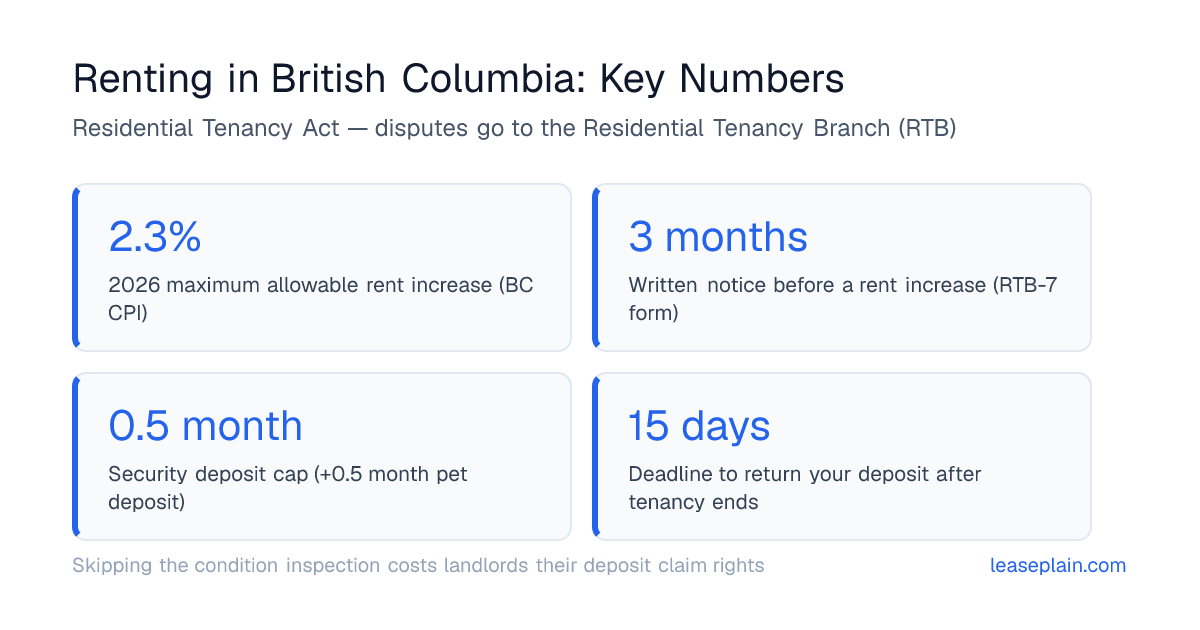
Key Tenant Protections in BC
- Security deposits are capped at one-half (0.5x) of one month's rent.
- Pet deposits are also capped at 0.5x one month's rent — and cannot be combined with the security deposit to exceed that amount.
- Landlords must give one month's written notice to end a tenancy for most reasons; tenants must give one month's notice. Note: personal use (landlord or close family member) and purchaser occupancy evictions require 3 months' notice (RTB-32L/RTB-32 forms); renovations or demolitions requiring a permit require 4 months' notice.
- Rent increases are limited to the annual allowable increase set by the province (tied to BC CPI). The allowable increase for 2026 is 2.3%, down from 3% in 2025.
- Landlords must give three months notice for rent increases tied to capital expenditures.
- Landlords must return security deposits within 15 days of tenancy end or the tenant's forwarding address being provided.
- Tenants can apply to the Residential Tenancy Branch (RTB) for dispute resolution at a low filing fee.
- Landlords cannot enter a unit without written notice (minimum 24 hours) except in genuine emergencies.
Fixed-Term Leases: The 2021 Rule Change
Before 2021, BC landlords commonly used fixed-term leases with end-of-term vacate requirements as a way to reset rent to market. A 2021 amendment to the RTA largely closed this loophole: landlords can only require tenants to vacate at the end of a fixed-term lease if the landlord (or a close family member) intends to occupy the unit, or the unit is being sold to a buyer who will occupy it, among other specific circumstances. Simply wanting to charge a new tenant more is not a valid reason.
What to Watch for in BC Leases
- Security deposits above 0.5x monthly rent — any amount above the cap is not legally collectible.
- Clauses waiving the pet deposit cap or charging both a security deposit and a pet deposit that together exceed one month's rent.
- "Diplomatic clauses" allowing landlords to end a fixed-term tenancy early — these must comply with the RTA and cannot simply override it.
- Fixed-term leases with "vacate at end of term" clauses — effective 2021, a landlord cannot require a tenant to vacate solely because a fixed-term lease ends, unless specific conditions apply.
- Rent increase provisions in the lease that permit increases at any time — not permitted under BC law.
BC Cities
Vancouver
Canada's most expensive rental market, RTB dispute volume high
Burnaby
Metro Vancouver city, SFU area, high-rise rental market
Surrey
BC's second-largest city, growing rental supply, diverse market
Victoria
BC capital, UVic student market, low vacancy rates
More BC cities coming soon — Kelowna, Abbotsford, and others.