Ontario Tenant Rights: Lease Help Under the Residential Tenancies Act
Ontario's Residential Tenancies Act (RTA) provides some of the strongest tenant protections in North America. From rent increase caps to accessible LTB hearings (filing fees are $186 online or $201 by paper; fee waivers available for low-income applicants), Ontario renters have significant rights — but only if they know them.
The Residential Tenancies Act & the LTB
The Residential Tenancies Act, 2006 governs almost all private residential rental units in Ontario. It sets out the rights and obligations of both landlords and tenants and establishes the Landlord and Tenant Board (LTB) as the tribunal for resolving disputes. The LTB hears applications about rent, maintenance, evictions, and a wide range of tenancy issues.
Tenants pay a filing fee of $186 online or $201 by paper when applying to the LTB; fee waivers are available for low-income applicants. Landlords also pay a filing fee. Applications can be filed online through the Tribunals Ontario portal, and hearings are typically conducted via videoconference. The LTB has authority to order rent abatements, repairs, and in some cases dismiss eviction applications.
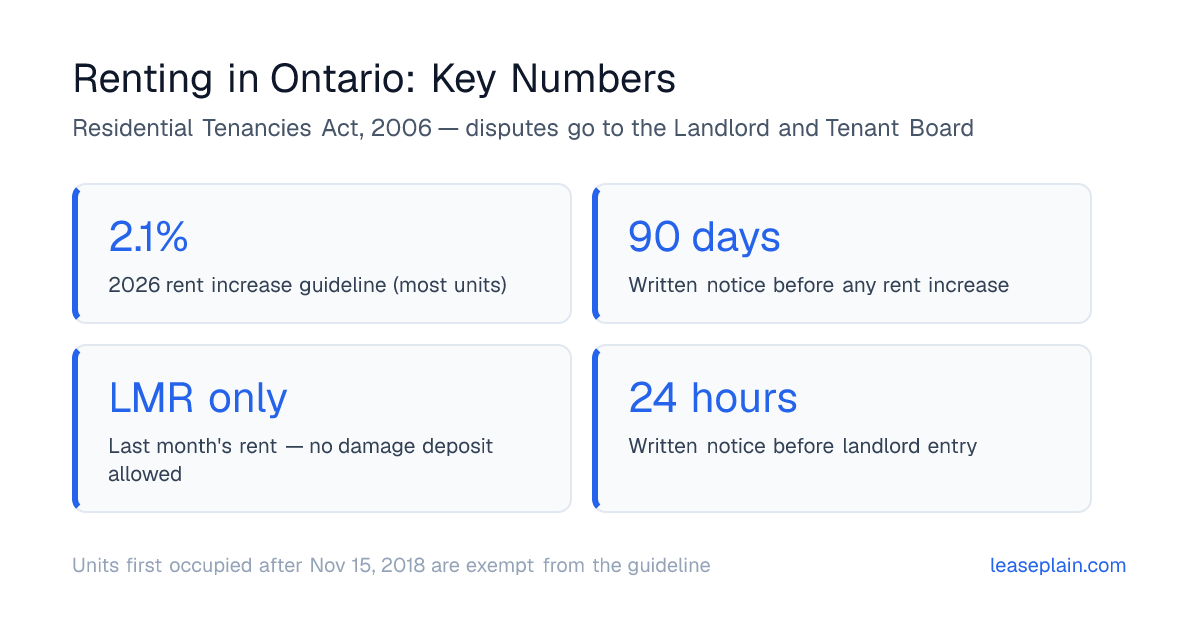
Key Tenant Protections Under the RTA
- A fixed-term lease expires on its end date without any notice required — the tenancy automatically converts to month-to-month if neither party acts. If a tenant on a month-to-month tenancy wishes to end the tenancy, they must give 60 days written notice (Form N9).
- Rent increases are limited to the provincial guideline (announced each year by the Ministry of Municipal Affairs and Housing).
- Landlords must use the standard Ontario lease form for most residential tenancies.
- Tenants can file applications with the Landlord and Tenant Board (LTB) — filing fees are $186 online or $201 by paper; fee waivers are available for low-income applicants.
- A landlord cannot evict a tenant for personal use without filing a valid Form N12 and paying one month's compensation — this applies regardless of notice period length.
- Above-guideline rent increases (AGI) require a formal LTB application by the landlord with documented evidence.
- Tenants have the right to sublet their unit — a landlord cannot unreasonably withhold consent.
- Security deposits ("last month's rent") are capped at one month's rent and must earn interest.
Form N12: Owner's Own Use
If a landlord wants to move into your unit (or have a close family member move in), they must serve you a Form N12 with at least 60 days notice and pay you one month's rent as compensation (under RTA s.48.1, this applies regardless of the length of notice given). If the landlord does not genuinely occupy the unit within a reasonable time, you may have grounds for a bad-faith eviction claim at the LTB, which can result in significant financial remedies.
What to Watch for in Ontario Leases
- "Rent-to-income" ratios or financial screening requirements that may conflict with the Human Rights Code.
- Clauses waiving the right to sublet or requiring the landlord's "sole discretion" on assignments.
- Early termination penalties above what is permitted under the RTA.
- Unauthorized fees — condo amenity fees, key fob fees, parking fees bundled into rent without disclosure.
- Clauses stating the landlord is not responsible for maintenance — these do not override the RTA duty to repair.
Ontario Cities
Toronto
Canada's largest rental market, condo-heavy, AGI hearings common
Ottawa
Government & student renters, competitive downtown core
Mississauga
GTA suburb, growing condo inventory, Ontario RTA applies
Hamilton
Fast-growing city, GTA spillover, strong tenant community
Brampton
Fast-growing GTA city, diverse rental market, Ontario RTA applies
London
University city, large student rental market, Western University area
Kitchener
Tech hub, growing rental demand, Waterloo Region proximity
Waterloo
University town, student-dominated rental market, Waterloo Region
Kingston
Queen's University city, strong student rental demand
Oshawa
Durham Region city, commuter belt, affordable GTA alternative