Quebec Tenant Rights: Lease Help Under the Civil Code & Housing Tribunal
Quebec's tenancy framework is unique in Canada. Governed by the Civil Code of Quebec and the Act Respecting Lessor and Lessee, Quebec renters deal with a mandatory standard lease form, strong renewal rights, and a specialized housing tribunal — the Tribunal administratif du logement.
Quebec's Unique Tenancy Framework
Unlike other provinces that have standalone residential tenancy statutes, Quebec's tenancy law is embedded in the Civil Code of Quebec and supplemented by the Act Respecting Lessor and Lessee. The Tribunal administratif du logement (TAL) — formerly the Régie du logement — is the specialized administrative tribunal that hears all residential lease disputes.
One of the most distinctive features of Quebec tenancy law is the mandatory standard lease form (bail). This form, available from the TAL, must be used for most private residential tenancies and sets out all mandatory and permitted terms. Custom clauses can be added, but they cannot reduce tenant rights below the statutory minimum.
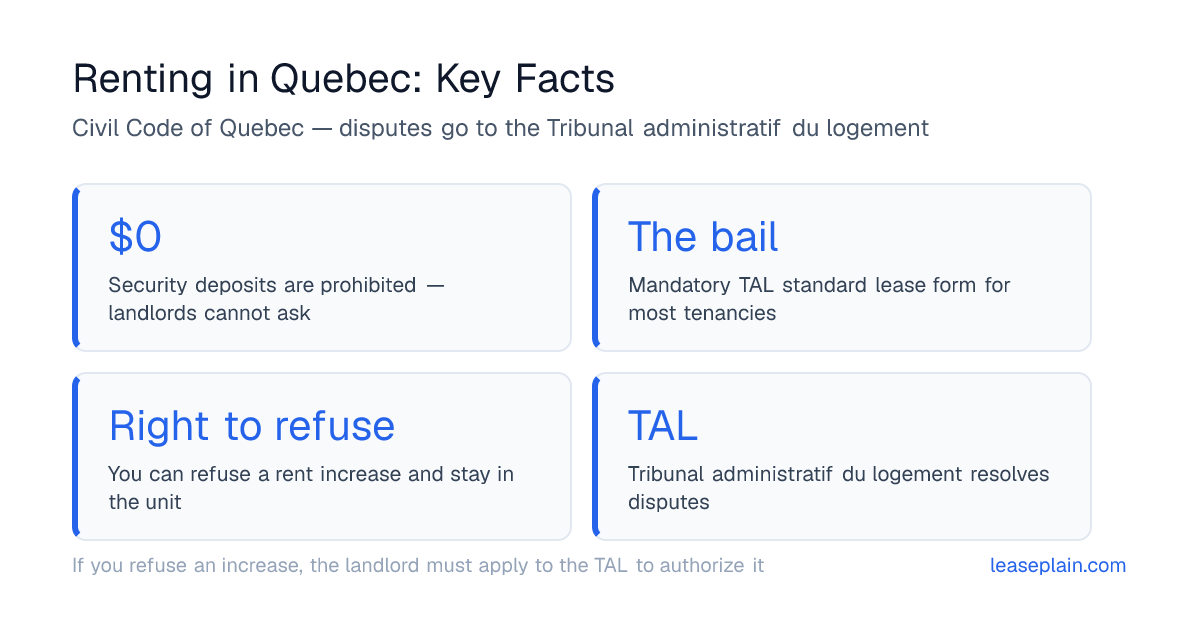
Key Tenant Protections in Quebec
- Landlords must use the standard lease form (bail) provided by the Tribunal administratif du logement (TAL) for most residential tenancies.
- Tenants have the right of first refusal — when a landlord wants to repossess a unit or substantially modify it, the tenant has priority to get it back.
- Rent increase notices must be sent in writing within a specific window: 3 to 6 months before lease end for fixed-term leases of 12 months or more; 1 to 2 months before lease end for leases under 12 months.
- Tenants have the right to refuse a rent increase — if refused, the landlord must apply to the TAL to have the increase authorized.
- Quebec has strong anti-eviction protections — a landlord cannot refuse to renew a lease without a valid reason recognized by law.
- Tenants 70 years of age or older who have lived in a unit for at least 10 years benefit from additional protection against repossession.
- The TAL handles lease disputes, rent determinations, and eviction proceedings — filing fees are low.
- Leases in Quebec automatically renew on the same terms unless a change notice is given within the required window.
July 1 Moving Day in Quebec
Quebec's unique "moving day" tradition stems from a historical quirk: most leases in the province run from July 1 to June 30, meaning thousands of tenants move on the same day each year. This creates significant logistical challenges — moving trucks are scarce and expensive, and landlords are flooded with overlapping move-ins. If you are planning to sign a lease in Quebec, confirm the lease start and end dates carefully, and book your movers as early as possible if your move coincides with July 1.
What to Watch for in Quebec Leases
- Lease terms that deviate from the mandatory standard bail form without the tenant's informed agreement.
- Rent increase notices that do not comply with the prescribed format or are sent outside the required notice window — these may be invalid.
- Clauses purporting to waive the tenant's right of first refusal on repossession.
- Informal "handshake" lease arrangements that omit key terms required by the Civil Code.
- Clauses in English-only leases — Quebec law requires leases to be in French; an English version may be provided but the French governs.
Quebec Cities
Montreal
Canada's largest rental market, bilingual leases, July 1 moving day
Quebec City
Provincial capital, lower vacancy than Montreal, French-language leases
Laval
Montreal suburb, growing rental market, TAL jurisdiction
More Quebec cities coming soon — Gatineau, Sherbrooke, and others.