Security Deposit Rules by Province: What Can Your Landlord Actually Charge?
Security deposit rules across Canada vary more than most renters realize. Quebec prohibits them entirely. Ontario only allows last month's rent. Alberta permits up to one month. Here is exactly what landlords can legally charge in every province — and what happens if they charge more.
Why Deposit Rules Differ So Much
In Canada, residential tenancy law is a provincial matter. There is no federal law governing security deposits, which means each province has set its own rules about how much landlords can collect, what conditions allow them to keep it, and how quickly they must return it when the tenancy ends.
The most dramatic example is Quebec, where collecting any form of deposit is outright illegal under the Civil Code of Quebec. Ontario goes a different route: landlords can only collect a "last month's rent" deposit — not a damage deposit — and that money must be applied to your final month of rent. Neither province allows landlords to hold money specifically to cover potential damage.
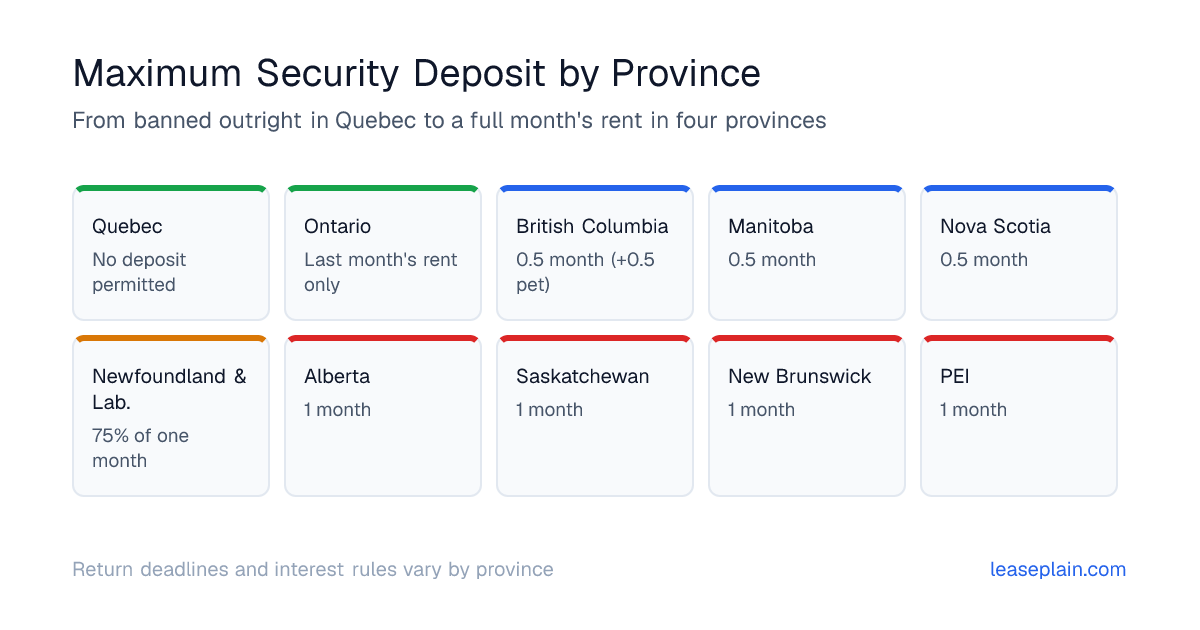
Deposit Rules at a Glance
| Province | Max Deposit | Return Deadline | Interest |
|---|---|---|---|
| Ontario | Last month's rent only (no damage deposit) | Applied to final month's rent — no separate return step | Yes — based on rent increase guideline rate |
| British Columbia | 0.5× one month's rent | 15 days after tenancy end or last day of fixed term | Yes — annual rate set by RTB |
| Alberta | 1× one month's rent (includes pet deposit) | 10 days after tenancy end | Yes — rate varies annually by regulation |
| Quebec | No security deposit permitted | N/A | N/A |
| Manitoba | 0.5× one month's rent | 14 days after tenancy end | Yes — prescribed rate |
| Saskatchewan | 1× one month's rent | 7 days after tenancy end | No |
| Nova Scotia | 0.5× one month's rent | 10 days after tenancy end | Yes — rate via provincial Security Deposit Interest Calculator |
| New Brunswick | 1× one month's rent | 7 days after tenancy end | No |
| PEI | 1× one month's rent | 10 days after tenancy end | Yes — at prescribed rate |
| Newfoundland & Labrador | 75% of one month's rent | 15 days after tenancy end | No |
What Landlords Cannot Charge For
Even in provinces that allow security deposits, there are strict limits on what landlords can deduct when returning the money. Generally, landlords can only deduct for:
- Damage beyond normal wear and tear
- Unpaid rent (in provinces where deposits can cover this)
- Cleaning costs if the unit was left significantly dirtier than when rented
Normal wear and tear — small nail holes, minor carpet wear, faded paint — cannot be deducted from a deposit. A landlord who claims excessive deductions must typically provide receipts and documentation. Without that, you can challenge the deduction through your province's tenancy tribunal.
If Your Landlord Overcharges or Doesn't Return It
If a landlord collects a deposit above the provincial limit, or refuses to return it after the deadline, you have options:
- Ontario: File a T1 application with the LTB for the return of an illegal charge.
- BC: Apply to the Residential Tenancy Branch for dispute resolution. The RTB can order a landlord to return the deposit.
- Alberta: Apply to the Residential Tenancy Dispute Resolution Service (RTDRS).
- Quebec: Report the collection of any deposit to the Tribunal administratif du logement (TAL) — it is illegal for a landlord to accept one.
Use our Security Deposit Return Calculator to find out exactly how much you should get back and what your province's deadline is.