First Apartment Checklist: 25 Things to Do Before and After Signing Your Lease in Canada
Renting your first apartment in Canada involves a lot more than just signing on the dotted line. This checklist walks you through 25 concrete action items — before you sign, at move-in, and during your first month — so you protect yourself from day one.
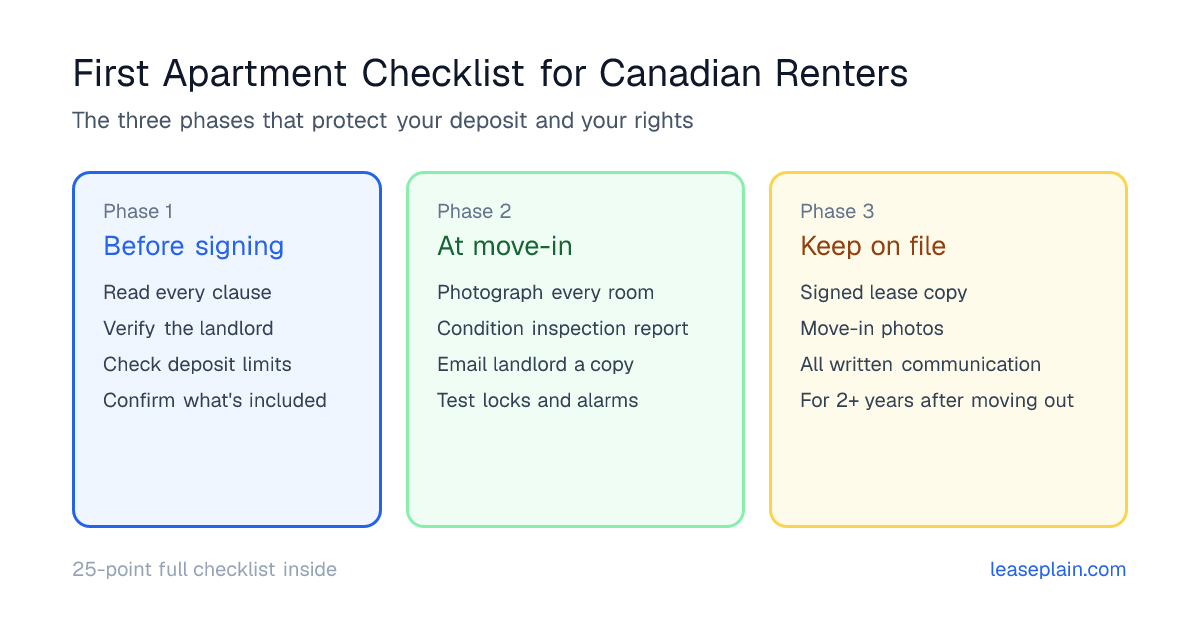
Before You Sign the Lease (Items 1–10)
The period before you sign is your strongest window to ask questions, spot red flags, and negotiate. Most tenants skip this — don't.
- 1
Get the lease in writing
Never rent on a verbal agreement. Oral leases exist but are almost impossible to enforce — if a dispute arises, it becomes a he-said she-said situation with no documentation to fall back on.
- 2
In Ontario: request the Standard Lease form
Mandatory since 2018. If your landlord doesn't provide it, request it in writing. They then have 21 days to comply — or you may be entitled to withhold one month's rent until they do.
- 3
Read every clause carefully
Pay special attention to: rent amount, deposit required, utilities included, pet rules, subletting rules, parking, and storage. If you don't understand a clause, ask — or upload it to LeasePlain for a plain-English explanation.
- 4
Check if your unit is rent-controlled
In Ontario, units first occupied for residential purposes after November 15, 2018 are exempt from rent increase guidelines. This means your landlord could raise rent significantly at renewal. Know before you sign.
- 5
Research the building's RentSafeTO score (Toronto)
Available at toronto.ca/rentsafe, this score gives a meaningful snapshot of building maintenance standards. A low score is a red flag worth investigating further.
- 6
Ask what deposits are required and verify the legal cap
Caps vary sharply by province: in Ontario, only last month's rent is permitted; in BC, the maximum is 0.5 months; in Quebec, no deposit is allowed at all. Anything beyond your province's cap is illegal.
- 7
Confirm who is responsible for which utilities
Get it in writing. If utilities are included, have the specific services named in the lease — "utilities included" is vague and has led to many disputes over whether internet, heat, or parking was covered.
- 8
Check for red flags in the lease
Watch for clauses that prohibit subletting entirely, impose excessive late fees (illegal in Ontario), or purport to waive your right to a habitable unit. These clauses are either void or a warning sign about the landlord.
- 9
Run a quick online check on the landlord
Search the LTB decisions database (public record) for the property address. A pattern of N12 notices (landlord's own use evictions) at the same address is a serious red flag.
- 10
Get renters insurance quotes
Typically $15–30/month for a first apartment. Not legally required, but essential — your landlord's building insurance covers the building, not your belongings or personal liability.
At Move-In (Items 11–18)
The first day sets the record for everything that follows. Protect your deposit by creating ironclad documentation before you unpack a single box.
- 11
Do a thorough walkthrough with your landlord before accepting the keys
Walk through every room together and note every imperfection — scratches, stains, chips, scuffs. If your landlord refuses to do a walkthrough, do it alone and document everything in writing the same day.
- 12
Take timestamped photos of every room
Photograph walls, floors, appliances, fixtures, closets, and any existing damage. Upload immediately to cloud storage you control (not just your phone). These photos are your single most powerful document if a deposit dispute arises at move-out.
- 13
Test everything that should work
Test all appliances, smoke detectors, carbon monoxide detectors, door locks (including deadbolts), windows (open, close, and lock), and every tap for hot water. Note any failures immediately in writing.
- 14
Document existing damage in writing and email it to your landlord
Send a move-in condition report by email within 24 hours of getting the keys. This creates a timestamped record. If your landlord later tries to charge you for pre-existing damage, this email is your defense.
- 15
In BC: complete a Condition Inspection Report (RTB-27)
This form is legally required in British Columbia. Both you and your landlord must sign it at move-in. If the landlord skips this step, they forfeit the right to make any deposit deductions at move-out.
- 16
Get a receipt for your deposit and first month's rent
In Ontario, landlords must provide receipts on request (Residential Tenancies Act, s.109). Keep this receipt for the entire tenancy — it proves you paid and confirms the deposit amount.
- 17
Confirm your landlord's contact details and emergency repair contact
You need a phone number and email for routine requests, and a separate after-hours or emergency contact for urgent repairs (no heat in winter, flooding, etc.). Get both in writing on day one.
- 18
Read the lease one more time now that you're in the unit
You will understand it differently when the physical space is in front of you. Clauses about parking, storage, garbage, and noise will mean more now than they did when you first read it.
Within Your First Month (Items 19–22)
- 19
Set up a dedicated folder for all landlord communications
Create an email folder — or a folder in Google Drive — specifically for lease documents, rent receipts, repair requests, and any landlord correspondence. A paper trail is essential if a dispute ever goes to tribunal.
- 20
Put your rent due date in your calendar with a 5-day reminder
Late rent is one of the most common grounds for N4 notices in Ontario. Even if your landlord is lenient, chronically late rent creates a legal paper trail that works against you.
- 21
Bookmark your province's tenant rights tribunal
Know where to go before you need to go there:
- Ontario: Landlord and Tenant Board — ltb.gov.on.ca
- BC: Residential Tenancy Branch — gov.bc.ca/rtb
- Alberta: RTDRS — alberta.ca/rtdrs
- Quebec: Tribunal administratif du logement — tal.gouv.qc.ca
- 22
Identify local tenant advocacy resources
These organizations provide free or low-cost help for tenants facing disputes: ACTO (Advocacy Centre for Tenants Ontario), TRAC (Tenant Resource and Advisory Centre, BC), and CPLEA (Centre for Public Legal Education Alberta).
Keep These Documents Forever (Items 23–25)
These three items are non-negotiable. Store them somewhere you will be able to find them long after you move out.
- 23
Keep your original signed lease — always
Scan it and store it in cloud storage in addition to keeping the physical copy. You will need it if disputes arise about what was agreed to — even years into the tenancy.
- 24
Keep all rent receipts (or e-transfer records) for the full tenancy
Receipts prove you paid. E-transfer confirmations work, but a formal receipt from your landlord is stronger. In Ontario, landlords must provide receipts on request under s.109 of the RTA.
- 25
Keep your move-in condition report and photos until at least 2 years after you move out
The limitation period for LTB applications is generally two years from the date a claim arises. Your move-in documentation could be essential for defending against a deposit deduction claim long after the tenancy ends.
Your Top 5 Rights as a New Tenant
These rights apply regardless of what your lease says. They exist in law and cannot be waived, even if a clause in your lease purports to take them away.
Right to a habitable unit
Your landlord must maintain the unit to health and safety standards. This obligation cannot be waived in a lease — a clause saying you accept the unit "as-is" in a substandard condition is void.
Right to quiet enjoyment
Your landlord must give 24 hours written notice before entering — and entry must be at a reasonable time. Unannounced visits are a violation of your rights.
Right to not pay illegal fees
No admin fees, no late fees (in Ontario), no deposits above provincial caps. If you were charged an illegal fee, you can apply to your tribunal for a refund.
Right to dispute
Your provincial tenancy tribunal is free or low-cost for tenants to access. You do not need a lawyer. The process is designed for self-represented applicants.
Right to not be evicted without a tribunal order
A notice to end your tenancy is not eviction. Your landlord must apply to the tribunal and obtain an order before you are legally required to leave. Notice alone has no force if you choose to stay and dispute it.