Tenant Maintenance Duties in Ontario: What You Are Legally Required to Upkeep
Ontario's Residential Tenancies Act imposes clear obligations on tenants — not just landlords. Under RTA s.33, tenants must maintain ordinary cleanliness. Under RTA s.34, tenants are responsible for damage caused by themselves or their guests. Failing either obligation can result in an N5 notice and LTB proceedings. Here is what the law actually requires.
The Statutory Foundation: RTA s.33 and s.34
Most Ontario tenants are familiar with their landlord's obligation to maintain the unit under RTA s.20. Fewer know that the Act also sets specific obligations running in the other direction — obligations placed squarely on the tenant.
RTA s.33 — Cleanliness
“The tenant is responsible for ordinary cleanliness of the rental unit, except to the extent that the tenancy agreement requires the landlord to clean it.”
RTA s.34 — Damage
“The tenant is responsible for the repair of undue damage to the rental unit or residential complex caused by the wilful or negligent conduct of the tenant, another occupant of the rental unit or a person permitted in the residential complex by the tenant.”
These two sections are the legal basis for nearly every landlord claim against a tenant for cleaning costs, repair costs, and property damage in Ontario. They are also the basis for an N5 notice — the formal warning a landlord issues when they believe a tenant has violated either obligation.
Your Four Core Maintenance Duties in Ontario
Ordinary Cleanliness (RTA s.33)
Maintain the unit in a state of ordinary cleanliness — the standard a reasonable person would apply in their own home. This means regular kitchen cleaning, bathroom maintenance, and not allowing garbage, mould, or pests to develop from neglect.
- Regularly clean the kitchen including stovetop, oven, and refrigerator
- Maintain bathroom cleanliness to prevent mould from soap and moisture
- Dispose of garbage in designated receptacles and not allow it to accumulate
- Ventilate properly — especially after showering and cooking
No Undue Damage (RTA s.34)
The tenant must not cause undue damage to the rental unit, the building, or the landlord's property. 'Undue damage' means damage that exceeds normal wear and tear — it includes damage caused by guests and other occupants.
- Do not punch holes in walls or damage drywall
- Avoid dragging heavy furniture across hardwood or tile
- Use door stops to prevent doorknob holes in walls
- Immediately report any accidental damage to your landlord in writing
Report Needed Repairs Promptly
While not expressly stated in the same terms as landlord obligations, tenants who fail to report a developing problem — a slow leak that becomes a major water damage event, or a pest sighting that leads to a building-wide infestation — can find that a tribunal holds them partly responsible for the escalation.
- Report water leaks or moisture intrusion immediately by email
- Notify your landlord in writing if you see signs of pests
- Report failing appliances (heating, water heater) as soon as you notice
- Do not delay reporting out of concern about inconvenience
Responsibility for Guests and Occupants
Ontario's RTA s.34 extends the tenant's obligations to cover the conduct of guests, family members, and anyone else the tenant allows into the unit or building. If your guest causes damage or creates a disturbance, it is legally your problem.
- Inform guests of building rules before they visit
- Do not allow guests to behave in ways that disturb other tenants
- Ensure children do not damage common areas or other units
- Document any accidental damage caused by guests and report it
The N5 Notice: What Happens When You Breach These Duties
When an Ontario landlord believes a tenant has violated their obligations under RTA s.33 or s.34 (or has otherwise substantially interfered with the reasonable enjoyment of the property), the landlord may issue an N5 notice (Notice to Terminate a Tenancy Early — Interfering with Others, Damage or Overcrowding).
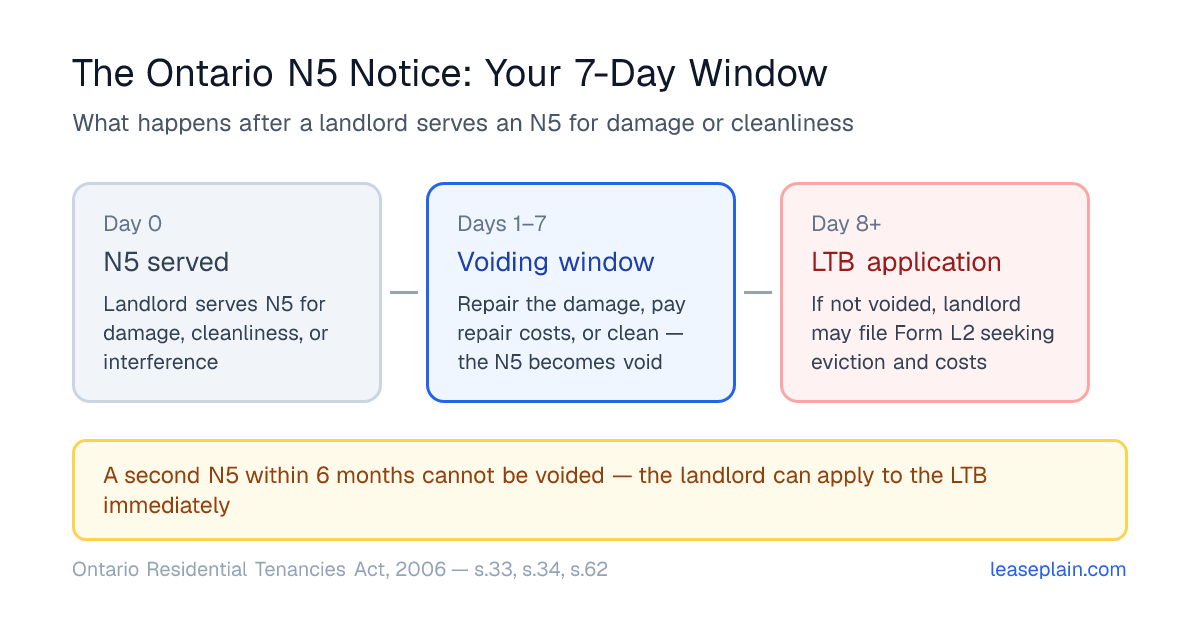
First N5 — Voidable
The tenant has 7 days from receiving the N5 to repair the damage, pay the cost of repair, or address the cleanliness issue. If the tenant complies within 7 days, the N5 is void and cannot be used to apply for eviction.
Second N5 Within 6 Months — Non-Voidable
If a second N5 is served within 6 months of the first, the tenant cannot void it by correcting the issue. The landlord can immediately apply to the LTB for an eviction order without giving the tenant another chance to fix the problem.
If you receive an N5, act immediately
The 7-day window to void a first N5 is firm. If the N5 identifies damage, arrange repairs within those 7 days and document that you did so — keep receipts and take dated photos of the repaired area. If you believe the N5 is unwarranted (e.g., the landlord is claiming damage that existed before your tenancy), gather your evidence and prepare for an LTB hearing.
How an Ontario Landlord Can Recover Repair Costs
If a landlord believes a tenant caused undue damage, they have two main paths to recover repair costs in Ontario:
- N5 notice followed by L2 application at the LTB. The landlord issues an N5, waits for the voiding period to pass (or serves a second N5 if warranted), and then files a Form L2 at the LTB. The L2 can request both compensation for the damage and an eviction order. The LTB will schedule a hearing and both parties can present evidence.
- Direct L2 application for compensation only. A landlord can also file an L2 solely for monetary compensation without seeking eviction. This is more common when the tenant has already moved out and the landlord wants to be compensated for damage discovered at move-out.
Critically, a landlord cannot simply apply the last month's rent deposit toward repair costs. The LMR deposit in Ontario can only be applied to the last month of rent — period. Using it for repairs without an LTB order entitles the tenant to file a T1 application to recover the amount wrongly applied.
How to Protect Yourself: A Practical Checklist for Ontario Tenants
Conduct a thorough move-in inspection
Photograph every room, surface, appliance, and fixture on move-in day. Email the photos to yourself and your landlord to create a timestamped record.
Report pre-existing damage in writing
If you notice damage at move-in that was not captured in the inspection, email your landlord the same day to create a record that it was pre-existing.
Keep the unit ordinarily clean
Maintain the kitchen, bathroom, and living areas to a reasonable standard. Address moisture issues promptly to prevent mould.
Report needed repairs in writing immediately
If you notice a problem — a leak, a crack, a failing appliance — send an email to your landlord the day you discover it.
Document any accidental damage you cause
If you or a guest accidentally damages something, photograph it and notify your landlord in writing before they discover it. Proactive disclosure protects against a second N5.
Respond to an N5 notice within 7 days
If you receive an N5, take it seriously. Address the issue within 7 days and document your remediation with photos and receipts.
Conduct a move-out inspection
Before vacating, photograph every room in the same way you did at move-in. Compare the photos side by side. If there are differences, decide whether they are your responsibility.