Normal Wear and Tear vs. Damage in Canadian Rentals: What Tenants Need to Know
Canadian landlords cannot charge tenants for normal wear and tear — ever. But the line between wear and tear and chargeable damage is often blurry, and deposit disputes hinge on it. This guide explains exactly what each concept means, how Canadian tribunals draw the line, and what every tenant should document before moving out.
What Is Normal Wear and Tear?
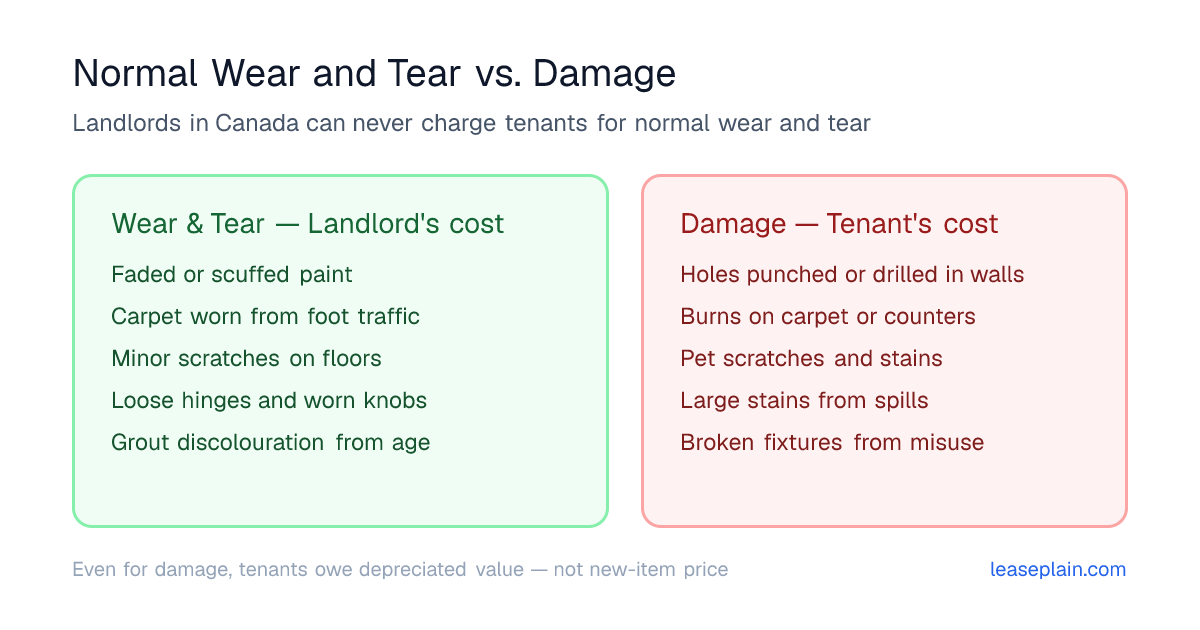
Normal wear and tear is the gradual, inevitable deterioration of a rental unit that results from ordinary, day-to-day living — not from negligence, carelessness, misuse, or accidents. It is the cost of having a property occupied, and Canadian law assigns that cost to the landlord, not the tenant.
While “wear and tear” is not defined in word-for-word in Ontario's RTA or BC's Residential Tenancy Act, it is a concept with a well-established meaning in landlord-tenant law and is applied consistently by the Ontario Landlord and Tenant Board (LTB), BC's Residential Tenancy Branch (RTB), and Alberta's Residential Tenancy Dispute Resolution Service (RTDRS). The core question each tribunal asks is: would a reasonable person living in the unit for that period of time have produced this level of deterioration? If yes — it is wear and tear.
Key factors that determine whether deterioration is wear and tear include the age of the item, the length of the tenancy, the nature of the use, and whether the deterioration was accelerated by something beyond ordinary use. A small scuff on the baseboard after five years is wear and tear; a deep gouge made by repeatedly dragging a refrigerator across the floor is not.
What Counts as Damage?
Damage is deterioration that results from something beyond reasonable, ordinary use — accidents, negligence, carelessness, misuse, or deliberate action. A burn in a carpet, a cracked bathroom tile from a dropped object, a hole in drywall from a thrown item, or large stains from an uncleaned spill: these are all damage.
The tenant is also responsible for damage caused by their guests or other occupants. If a friend visits and breaks a window, or if a child in the household draws on the walls, that falls on the tenant — not the landlord. Ontario RTA s.34 is explicit on this point.
Damage must be proven
In any Canadian province, a landlord who claims the tenant caused damage must prove it. That means evidence of: (1) the unit's condition at move-in, (2) the unit's condition at move-out, (3) the difference is attributable to the tenant, and (4) the repair cost is reasonable. Without a move-in inspection report, proving that the damage was not pre-existing is difficult — which is why tenants should always insist on one.
Room-by-Room Guide: Wear and Tear vs. Damage
| Item | Wear & Tear (Landlord) | Damage (Tenant) |
|---|---|---|
| Paint & Walls | Faded paint, small scuffs from furniture, minor marks at doorknobs, gradual yellowing | Large holes from anchors, unauthorized paint colour, grease stains, smoke staining throughout |
| Carpet & Flooring | Worn-down fibres from traffic, light matting, minor indentations from furniture legs | Burns, pet stains, large spill stains, gouges from dragging furniture, torn sections |
| Hardwood | Minor surface scratches from everyday use, slight dulling of finish over years | Deep gouges, water damage from unaddressed spills, scratches from pet nails across large areas |
| Appliances | Normal depreciation, worn knobs, minor interior staining from cooking | Broken burners from impact, burned interiors from unattended cooking, cracked glass from misuse |
| Fixtures & Hardware | Faded finish on faucets, slow draining from age, loose hinges from repeated use | Cracked toilet seats, broken cabinet hinges, missing handles, bent towel bars |
| Windows & Doors | Stiff locks from age, faded window frames, draft from seal deterioration | Broken glass from impact, damaged locks from forced entry by tenant, missing door stops |
| Bathroom | Soap scum buildup, mild grout discolouration from water over years | Mould from tenant's failure to ventilate, cracked tiles from dropped objects, broken fixtures |
How Depreciation Works: You Don't Owe the Full Replacement Cost
Even when a tenant has genuinely caused damage, Canadian tribunals apply depreciation when calculating how much the tenant owes. The principle is straightforward: you are only liable for the remaining useful life of the damaged item — not the cost of replacing it with something brand new.
For example: a carpet has a typical useful lifespan of 10–15 years. If a 7-year-old carpet is damaged by a tenant and would cost $1,500 to replace, the tenant would only owe a fraction of that — roughly $375 to $750, depending on how the remaining useful life is calculated (if the carpet had 3–8 years of life left).
Typical Useful Life Estimates Used by Canadian Tribunals
- Carpet10–15 years
- Interior paint5–7 years
- Hardwood flooring25+ years
- Appliances10–15 years
- Bathroom fixtures15–25 years
- Blinds / window coverings5–10 years
The Move-In Inspection: Your Most Important Tool
The best protection against a wrongful damage charge is a thorough move-in inspection report. Before or on your first day in the unit, walk through every room and document the existing condition of every surface, fixture, appliance, and fitting.
In British Columbia and Alberta, the move-in condition inspection is a legal requirement for landlords. In BC, a landlord who fails to complete a condition inspection at both move-in and move-out loses the right to make any claim against the security deposit, regardless of what damage occurred. This is one of the most tenant-protective provisions in Canadian rental law.
In Ontario, there is no statutory move-in inspection requirement, but it is strongly recommended. Without one, proving pre-existing conditions becomes a credibility contest — and photographed, timestamped evidence from day one of a tenancy is far more persuasive than a landlord's verbal claim that the damage did not exist before.
Province-by-Province: Security Deposits and Damage Claims
Ontario
No security deposit — landlords can only collect last month's rent (LMR). The LMR cannot be used for damage claims without an LTB order. A landlord must file a Form L2 at the LTB to claim compensation for tenant-caused damage. Tenants can dispute damage claims at the LTB via a T1 if the LMR is wrongly applied.
British Columbia
Security deposit capped at half a month's rent. Landlord must complete a condition inspection at move-in and move-out, or they lose the right to claim against the deposit entirely. Disputes go to the RTB. A landlord who wrongly withholds a deposit can be ordered to pay double.
Alberta
Security deposit capped at one month's rent (RTA s.43). Both parties must complete the move-in inspection for the landlord to claim against the deposit. If no inspection occurs, the landlord forfeits their right to deductions. Disputes go to the RTDRS or Provincial Court.
Quebec
No security deposits of any kind — Civil Code art. 1904 prohibits them outright. Landlords can only sue through the TAL to recover proven damage costs after the tenancy ends.