What Repairs Are Tenants Responsible For in Canada?
Canadian landlords must maintain the rental unit — but tenants are legally responsible for damage they cause. Understanding where that line sits can prevent a costly dispute at move-out. Here is a province-by-province breakdown of tenant repair obligations, what counts as your problem to fix, and what your landlord must handle.
The Legal Framework: Landlord Maintains, Tenant Does Not Damage
Across every Canadian province, residential tenancy legislation divides repair responsibility along the same fundamental line: landlords must maintain the property; tenants must not damage it.
In Ontario, the Residential Tenancies Act, 2006(RTA) sets this out in two sections. Section 20 requires the landlord to “maintain a rental unit in a good state of repair and fit for habitation.” Section 33 then imposes a parallel obligation on tenants: they must “maintain the unit in a state of ordinary cleanliness.” Section 34 goes further — if a tenant or their guest causes undue damage, the tenant is responsible for the cost of repair.
In British Columbia, section 32 of the Residential Tenancy Actmirrors this: the landlord must maintain the unit in a state of repair, while tenants must keep the unit reasonably clean and not cause damage beyond normal use. Section 7(1)(c) of BC's Act confirms that the tenant must not significantly interfere with or disturb the reasonable enjoyment of others — including not causing damage to the property.
In Alberta, section 21 of the Residential Tenancies Act requires tenants to keep the premises reasonably clean and not cause or permit damage beyond normal use. The tenant is also required to notify the landlord promptly when damage or needed repairs become apparent — failing to report a problem that then worsens can shift liability to the tenant.
In Quebec, article 1971 of the Civil Code of Québec holds the tenant responsible for any deterioration they cause to the dwelling, and article 1973 requires tenants to carry out minor maintenance repairs as defined by regulation — these are small upkeep tasks (replacing smoke detector batteries, lubricating hinges) that fall on the tenant regardless of who caused the wear.
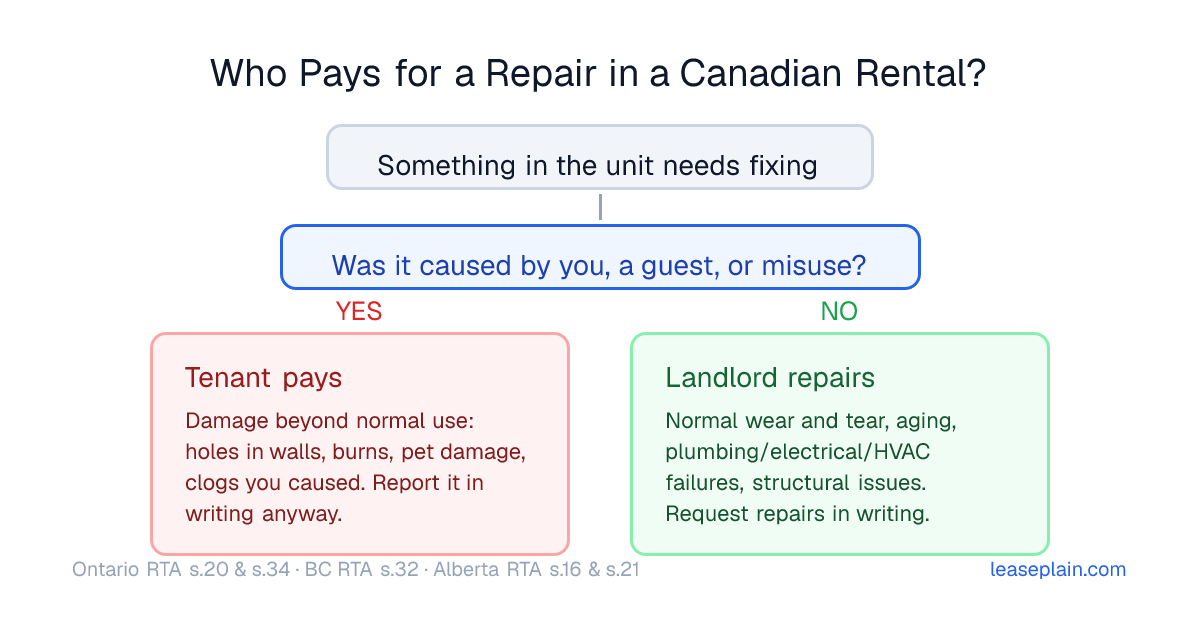
Quick Reference: Who Fixes What?
Always Tenant's Responsibility
- Damage caused by the tenant, their guests, or other occupants
- Broken windows from tenant actions (thrown objects, accidents)
- Holes in walls from hanging items improperly or from alteration
- Burns on carpets, countertops, or flooring from cigarettes or heat
- Pet damage — scratches, stains, chewed baseboards
- Drain clogs caused by grease, hair, or other tenant-introduced material
- Broken fixtures or appliances due to misuse
- Pest infestations caused by tenant's conduct or negligence
Always Landlord's Responsibility
- Structural repairs (walls, roof, foundation, flooring)
- HVAC and heating systems (not caused by tenant misuse)
- Plumbing infrastructure and water supply systems
- Electrical systems and wiring
- Exterior doors, windows, and locks
- Normal wear and tear on paint, carpets, and fixtures over time
- Pest infestations not caused by tenant conduct
- Common area maintenance
The Damage vs. Wear and Tear Distinction
The single most important concept in tenant repair law is the distinction between normal wear and tear and tenant-caused damage. Normal wear and tear is deterioration that happens from ordinary, reasonable everyday use — and it is the landlord's problem, not the tenant's.
Wear and tear includes things like: paint fading over time, small scuffs on walls from furniture placement, carpet fibres wearing down from foot traffic, minor scratches on hardwood from everyday use, and the gradual yellowing of grout in bathrooms. These are consequences of living in a space — a court or tribunal will not hold a tenant liable for them.
Damage, by contrast, is something beyond what reasonable use would produce: a large hole punched in drywall, a cigarette burn on a countertop, deep gouges in hardwood flooring from dragging heavy furniture, shattered tiles from impact, or a bathroom fan destroyed from someone hanging from it. These cross the line from ordinary use into damage — and the cost to restore the unit falls on the tenant.
The Depreciation Question
Even when a tenant has caused damage, they are generally only liable for the current depreciated value of the item — not the full replacement cost of a brand-new version. If a 12-year-old carpet is burned and a new carpet costs $2,000 but the old one had a useful life of 15 years, the tenant may only owe roughly $400 (the remaining 3 years of value). Ontario LTB arbitrators and BC RTB arbitrators both apply this principle.
Specific Scenarios: Who Pays?
Broken window
Tenant's responsibility if caused by their action or their guest's action. Landlord's responsibility if caused by age, seal failure, thermal stress, or weather.
Clogged drain
Tenant's responsibility for clogs caused by hair, grease, or objects they put down the drain. Landlord's responsibility for plumbing system failures, root intrusion, or collapse.
Mould
Landlord's responsibility if caused by structural water penetration, roof leaks, or inadequate ventilation in the building. Tenant's responsibility if caused by consistently leaving windows closed in a humid unit without running the bathroom exhaust fan, or by drying clothes indoors without ventilation.
Pet damage
Tenant's responsibility. Scratches on floors, doors, or walls caused by a pet are damage beyond normal wear and tear regardless of whether the landlord agreed to the pet.
Appliance breakdown
Landlord's responsibility if the appliance is included in the rental and breaks down from age or malfunction. Tenant's responsibility if the appliance breaks from misuse — running an oven without proper ventilation, overloading a dishwasher, or forcing an ice maker.
Pest infestation
Landlord's responsibility in most cases — building-wide infestations almost always arise from building conditions. Tenant's responsibility if the infestation is confined to their unit and clearly caused by their conduct (e.g., leaving garbage indoors, hoarding food waste).
Reporting Obligations: When Tenants Must Tell the Landlord
Even when a repair is the landlord's responsibility, tenants have an obligation to report problems promptly. In Alberta, this is explicit in the statute. In Ontario and BC, it is implied — a tenant who notices a roof leak and says nothing for months while the damage spreads may find that a portion of the resulting damage is attributed to them for failing to mitigate.
Always report in writing
When you discover a problem — whether it's your fault or the landlord's — send a written notice immediately. Email is best. If a landlord later claims you caused damage by not reporting a leak or pest problem, having a timestamped record showing you did report it protects you entirely.
What Landlords Can and Cannot Do to Recover Repair Costs
When a tenant causes damage, landlords have legal avenues to recover the cost — but they cannot simply help themselves. In Ontario, a landlord cannot deduct repair costs from a last month's rent (LMR) deposit without an LTB order. If a landlord does this, the tenant can file a T1 application to recover the improperly applied amount.
The landlord's correct path in Ontario is to file an L2 application at the LTB for compensation for damage. They must prove on a balance of probabilities that: (1) the damage exists and was not present at the start of tenancy, (2) it was caused by the tenant or their guest, and (3) the claimed repair cost is reasonable.
In British Columbia and Alberta, the landlord can apply to the RTB or RTDRS respectively to recover proven repair costs caused by the tenant. In BC specifically, a landlord can also apply to retain a security deposit — up to half a month's rent — and must do so through the RTB; they cannot simply keep it without notifying the tenant and providing an opportunity to dispute.
In Quebec, there is no security deposit — landlords must pursue damage claims through the Tribunal administratif du logement (TAL) directly.